
Reviewed · AIX-EN-PROVENCE TOURS
An Authentic and Warm Visit to Aix en Provence
Aix can feel like a postcard, but today you’ll see how it works. This 2.5-hour walking tour in Aix-en-Provence threads together major sights and the quieter architectural details you’d miss alone. I especially loved the way the guide, Caroline, turns each stop into a story you can picture, and how you get practical orientation fast while still getting real depth.
The main trade-off: it’s a tight route with short photo stops (often around 10 minutes), so if you want to linger in one place, you’ll need to save extra time for a second visit later.
In This Review
- Key highlights I’d bet you’ll like
- Aix-en-Provence in 2.5 Hours, Without Feeling Lost
- From the Rotonde to Cours Mirabeau: Where Aix Shows Its Face
- Mazarin District: Hôtel de Caumont and the Quatre-Dauphins Fountain
- Saint-Jean-de-Malte and the First Gothic in Provence
- King René to Cour d’appel: Fountains and the Palace Layering
- Rue Espariat, Place d’Albertas, and the Daily Rhythm of Place Richelme
- Town Hall Square, the Tapestry Museum Corner, and the Cathedral Close-Up
- Price and Value: What $90.22 Buys You Here
- Practical Tips: Pacing, Photos, and Getting the Most From Short Stops
- Who This Tour Suits Best (and Who Might Feel Impatient)
- Should You Book This Aix-en-Provence Tour?
- FAQ
- What is the duration of the tour?
- How much does the experience cost?
- What language is the tour offered in?
- Where do we meet, and does it end nearby?
- How large is the group?
- Are admissions included for the stops?
- Is a souvenir included?
- Are tips included in the price?
- Is there a cancellation window for a full refund?
Key highlights I’d bet you’ll like
- Caroline’s warm, detailed guiding with maps/photos and a personal feel for the city
- Fountain-and-square Aix route that shows the town’s main visual landmarks
- Mazarin District stops like Hôtel de Caumont’s art setting and the 17th-century Fontaine des Quatre-Dauphins
- Cathedrale Saint-Sauveur + cloister time so you leave with more than just streets and façades
- Free entry at multiple stops plus a small included local souvenir
Aix-en-Provence in 2.5 Hours, Without Feeling Lost
If you only have a morning or early afternoon in Aix, this is the kind of tour that helps you lock in the city layout. You start at the Tourist Information Center on Av. Giuseppe Verdi, then head out on foot to landmarks clustered in the center—so you spend your time looking, not figuring out where to go next.
This is built for small groups too. You’re capped at 12 travelers, which makes it easier for the guide to answer questions and adjust pacing. That matters in Aix, where everyone wants photos from the same angles and some streets funnel you into crowds. With a small group, you generally move at a rhythm that feels human.
And yes, the route is sightseeing-heavy—but it’s not just a checklist. The guiding focus is on why these places matter, how Aix evolved, and how the city’s “big postcard moments” connect to everyday life: squares, markets, church architecture, and the feel of residential streets.
Over to Aix-en-Provence, more days out



From the Rotonde to Cours Mirabeau: Where Aix Shows Its Face
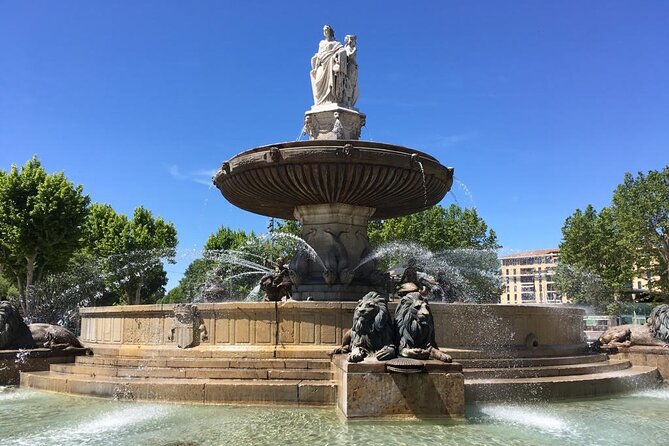
You begin at Fontaine de La Rotonde, the monumental fountain built in 1860 and a signature symbol of Aix. It’s one of those spots where you can stand, orient yourself, and immediately understand why locals treat fountains as meeting points and identity markers—not just decoration.
Next comes Cours Mirabeau, Aix’s most famous artery: cafés spilling onto terraces, mansions behind ironwork, and that classic Provençal “glide along the boulevard” vibe. What I like here is that you’re not only admiring the long views. You’re also getting historical context for the buildings lined up along it—especially when you stop in front of Hôtel de Villars, a 17th-century residence tied to the governor of Provence. That single detail helps the street stop being generic and start feeling like it has layers.
A practical tip: if you care about photos, this is where you’ll want to be ready with your camera. The Cours Mirabeau views are scenic, but they’re also busy. A short, guided stop is exactly what keeps your pictures from turning into a forever-wait.
Mazarin District: Hôtel de Caumont and the Quatre-Dauphins Fountain
After the main boulevard energy, the tour shifts into the Mazarin District, where Aix gets more refined and intimate. You’ll visit Hotel de Caumont – Art Centre, described as a standout 18th-century mansion in the Mazarin area. Even if you don’t go deep into galleries, stepping into a grand former residence helps you grasp Aix’s “wealth translated into architecture” story.
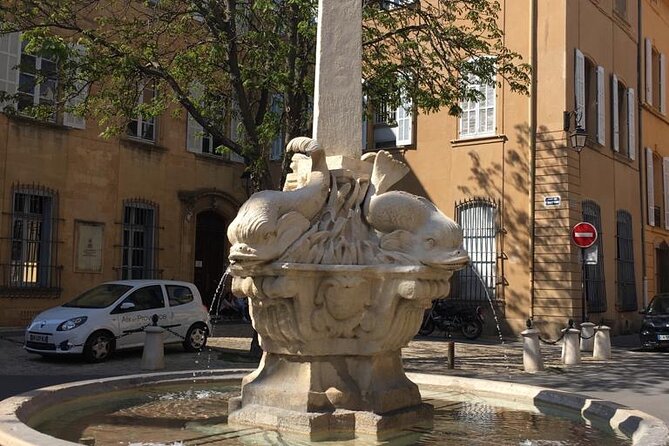
Then you’ll head to Fontaine des Quatre-Dauphins, a 17th-century fountain positioned in the center of Mazarin. This is one of those fountain stops where the guide’s approach pays off: you’re not just seeing a carved feature, you’re learning how fountains function as focal points in the city’s urban design.
A small warning (not a dealbreaker): these are “look + listen + move” moments. If you’re the type who wants to study stonework for an hour, you might feel slightly rushed at some stops. The counterbalance is that you’ll still learn what to notice, so a quick stop can become meaningful.
Saint-Jean-de-Malte and the First Gothic in Provence
Next up is Eglise Saint-Jean-de-Malte, built in the 13th century and noted as the first Gothic church in Provence. This stop is a nice pivot point: you get away from fountains and façades and into the geometry of religious architecture.
Right alongside is the Granet Museum, which the route presentation connects to the church. That pairing is useful. Even if you’re not planning museum time today, you’ll understand that this corner isn’t random—it’s part of a cultural cluster that shaped Aix’s public life.
What I like about this stop is how it gives you a sense of Provence beyond “sun and stone.” Gothic church design carries its own mood—light, height, structure—and it helps you see why Aix became a place people wanted to build, study, and gather for centuries.
King René to Cour d’appel: Fountains and the Palace Layering
The tour then hits Fontaine du Roi René, a quick stop (about 5 minutes) tied to the emblematic King René, described here as the last Count of Provence. Even in a short time window, the takeaway is clear: Aix’s public spaces borrow identity from notable figures, and those identities still show up in street-level details.
After that, you’ll pass through a picturesque passage created in 1846 between Cours Mirabeau and the Palais de Justice at Place Verdun. This is where Aix stops being just “pretty blocks” and starts becoming a place with actual urban history—especially with the detail that Félicien Agard bought a large part of the former convent of the Grands Carmes. That kind of story makes an alleyway feel like a timeline, not a shortcut.
You’ll also reach Cour d’appel – Palais Verdun, a 19th-century palace of justice built on the site of the former Count’s Palace. Again, layering is the theme. You see how old power gets replaced, but the city footprint stays. It’s one of the best ways to understand Aix as an evolving city instead of a static museum.



Rue Espariat, Place d’Albertas, and the Daily Rhythm of Place Richelme
Now you shift into the “Aix that feels lived-in” section.
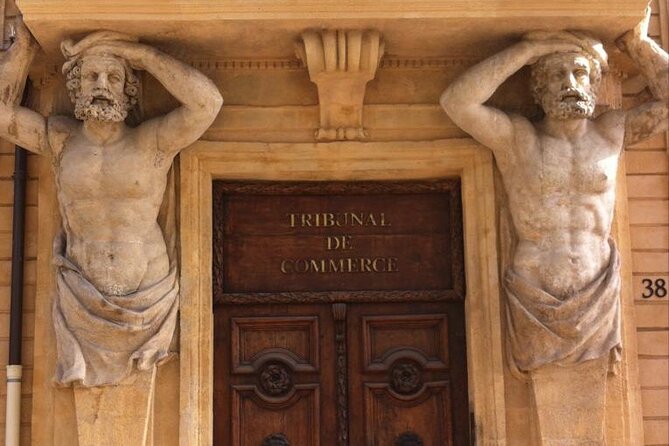
First, Rue Espariat, with Hôtel Boyer d’Eguilles—a 17th-century townhouse known for its monumental façade and colossal Corinthian pilasters. This is where your guide’s attention to architectural details matters. Those columns are the kind of feature you can walk past for years without noticing what they’re doing and why they look the way they do.
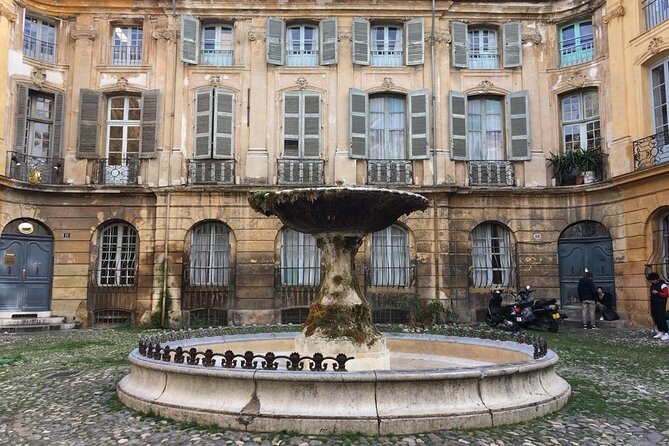
Then it’s Place d’Albertas, often described as charming for its harmonious façades and restored cobblestone look, plus a fountain in the square. I like square stops because they give you a breathing moment: you can look up at façades, check your bearings, and let Aix’s scale sink in.
From there, you reach Place Richelme, which hosts a local producers’ market every day. That’s a big deal for how the city feels. Even if you just glance at the market rhythm, you’re learning that Aix’s center isn’t only historic—it’s active, with daily routines happening around the same stone walls for years.
Town Hall Square, the Tapestry Museum Corner, and the Cathedral Close-Up
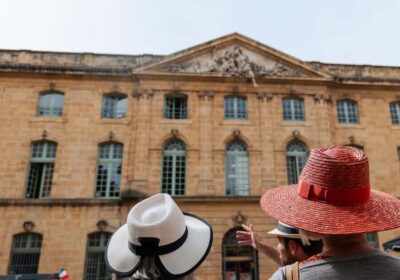
The tour continues toward Town Hall Square (Place de l’Hôtel de Ville), created by the pavillon and sculptors Rambot and Fossé. You’ll also see the former grain market setting and a notable pediment by Jean-Pancrace Chastel, plus a clock tower (the belfry). This stop is a good reminder that civic life shaped Aix as much as religion and aristocracy.
Next comes Place de l’Archevêché, also linked with Place des Martyrs de la Résistance, where the former 18th-century Archiepiscopal Palace is now home to the Tapestry Museum. Even if you don’t go inside during the tour window, seeing the site and connecting it to museum use helps you understand how Aix repurposes its grand buildings instead of freezing them in time.
Finally, the highlight-feeling landing spot: Cathedrale St. Sauveur. It sits on the site of the ancient forum and has been remodeled multiple times, mixing Romanesque, Gothic, and Baroque elements. You’ll also hear about the baptistery from the 6th century and a pretty cloister. This is one of those stops where you’ll appreciate the guided sequencing: you’re ready to notice transitions between styles, rather than just seeing one big “cathedral” and moving on.
If you’re into photos, don’t spend all your camera time at the entrance. The cloister area is often the moment where the cathedral turns from monument to calm.
Price and Value: What $90.22 Buys You Here
At $90.22 per person for roughly 2 hours 30 minutes, this tour sits in the “worth it if you’re short on time” category. You’re not only paying for a walk. You’re paying for a trained guide (Caroline) who can help you understand what you’re seeing and where to look.
A big value point: multiple stops have free admission tickets listed. That’s not always true on walking tours. Here, it supports the idea that the cost is tied to access and interpretation—not just standing on a sidewalk pointing.
Also, the group limit of 12 travelers is a value feature. You’ll get more back-and-forth attention without feeling like you’re part of a marching line.
And you’ll receive a little local souvenir included. It’s small, but it’s a nice touch and a concrete reminder after you’ve gone home.
Practical Tips: Pacing, Photos, and Getting the Most From Short Stops
Because this route is built from short segments—often around 10 minutes at many major sites—you’ll enjoy it more if you come in with the right mindset.
- Bring comfortable shoes. The whole time includes walking between stops, and you’ll be moving at city-center pace.
- Plan for quick photo bursts. For each site, decide what you want: façade, fountain details, or a wide street view.
- Ask questions as you walk. This tour is the type where a question can unlock the next building in line.
If you’re traveling with kids, note that children are admitted from 7 years old. That said, Caroline’s style is consistently described as attentive and engaging, and that kind of energy helps families keep the experience from turning into adult-only lectures.
Who This Tour Suits Best (and Who Might Feel Impatient)
This is ideal if you:
- Want to orient yourself fast in Aix and understand what you’re looking at
- Appreciate architecture and public spaces like fountains, churches, and civic buildings
- Prefer a small group with a guide who answers questions and keeps momentum
You might feel less thrilled if you:
- Want long museum time or lots of unstructured wandering
- Prefer to go at your own pace without any “move to the next stop” pressure
That doesn’t make it bad—it just means you’d pair it well with extra self-guided time afterward.
Should You Book This Aix-en-Provence Tour?
If you’re debating, here’s my straightforward take: book it when you want a smart first pass through Aix’s center. You’ll leave with a mental map, a set of stories tied to landmarks (not just facts), and a clearer sense of why places like Cours Mirabeau, the Mazarin fountains, and Cathedrale St. Sauveur matter.
Skip it if you already know Aix well and you’re mainly looking for open-ended roaming. Also, if your travel style is to linger at one site for a long time, treat this as your “get oriented and learn the key sights” layer—then return later for slow time.
Bottom line: for the price, the small group size, the free-access stops, and Caroline’s warm, detail-focused style, this is a strong way to make your Aix day feel purposeful instead of accidental.
FAQ
What is the duration of the tour?
The tour takes about 2 hours 30 minutes, and that total includes walking time between sites.
How much does the experience cost?
The price is $90.22 per person.
What language is the tour offered in?
The tour is offered in English.
Where do we meet, and does it end nearby?
You meet at the Tourist Information Center, 300 Av. Giuseppe Verdi, 13100 Aix-en-Provence, France and the tour ends back at the meeting point.
How large is the group?
The tour has a maximum of 12 travelers.
Are admissions included for the stops?
Many stops are listed with free admission tickets, including fountains, church areas, and specific monuments on the route.
Is a souvenir included?
Yes, a little local souvenir is included.
Are tips included in the price?
No, tips are not included.
Is there a cancellation window for a full refund?
Yes. You can cancel up to 24 hours in advance for a full refund. If you cancel less than 24 hours before, the amount paid is not refunded.
More Tour Reviews in Aix en Provence

A Day Over in Aix-en-Provence
Just Added: Fresh Marseille Reviews










Aix-en-Provence Tours, compared.
 ★ 4.1Aix-en-Provence: Lavender Fields VisitFrom $11421 reviews
 ★ 5.0Luberon Villages Half-Day Tour from Aix-en-ProvenceFrom $127414 reviews
 ★ 4.8From Aix-en-Provence: Luberon Hilltop Villages Half-Day TourFrom $123369 reviews
 ★ 5.0Luberon Market & Villages Day Trip from Aix-en-ProvenceFrom $181250 reviews
 ★ 5.0Provence Lavender Fields Tour from Aix-en-ProvenceFrom $108241 reviews
 ★ 5.0Cotes de Provence Wine Tour from Aix-en-ProvenceFrom $119239 reviews
 ★ 4.5Cassis & Aix-en-Provence Half-Day TourFrom $116237 reviews
 ★ 4.7From Aix-en-Provence: Valensole Lavender Full-Day TourFrom $182222 reviews
Browse the lists this tour appears in